

Foundation Squaring Calculator
AxelStack · Tools
Square any foundation layout. Diagonal check, off-square fix, L-shapes.
Available now on Google Play & the App StoreAvailable on Google Play and the App Store.

Screenshots
About this app
Get the corners right before you pour.
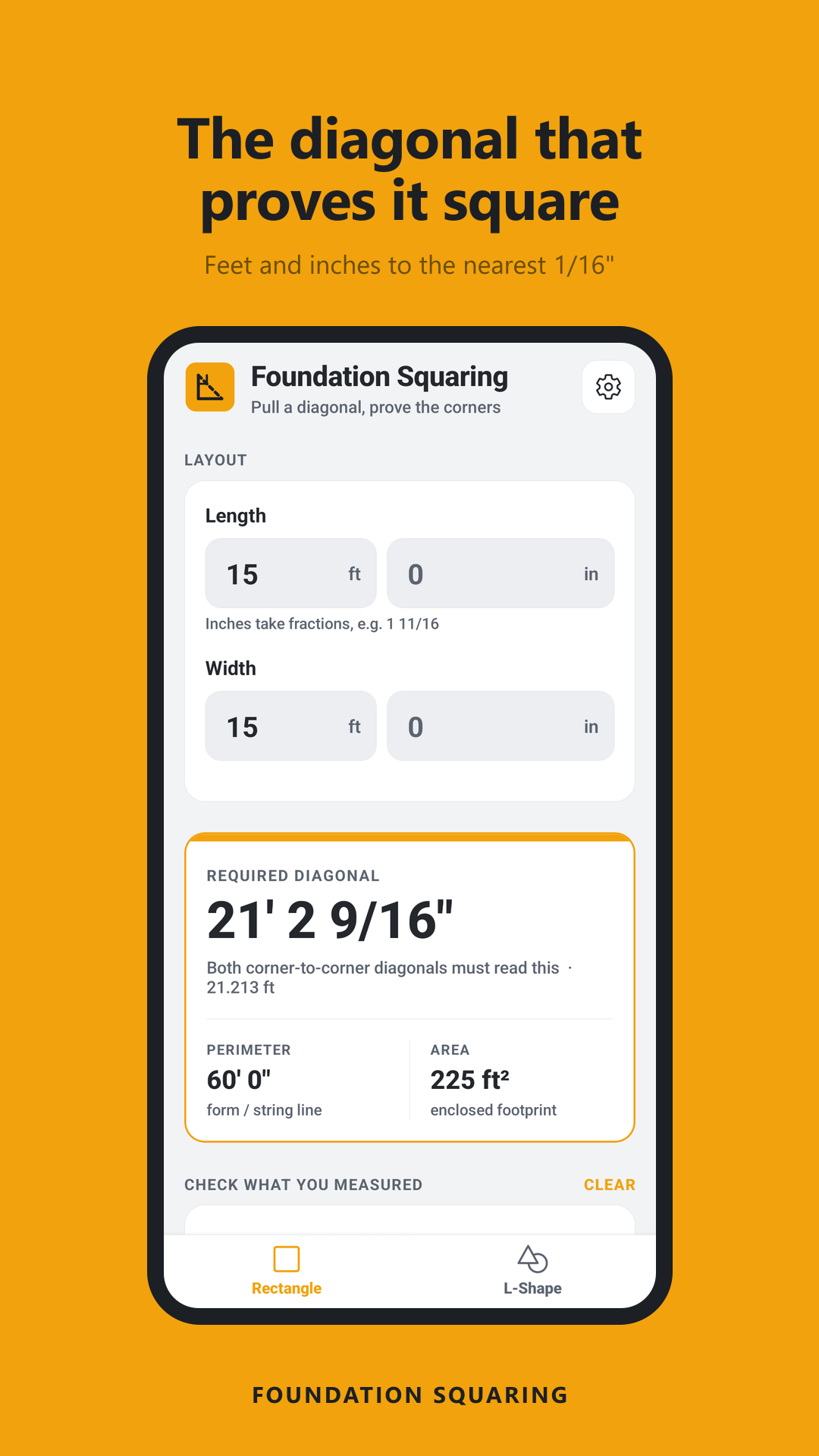
Enter your length and width and the app gives you the diagonal a square layout has to measure — in feet and inches to the nearest 1/16", or in meters. Pull both corner-to-corner measurements, type them in, and it tells you whether you're square and exactly how far to move a corner if you aren't.
What it does
- Required diagonal — the measurement both corner-to-corner pulls must match, shown as a tape reading and a decimal, plus perimeter for your string line and enclosed area.
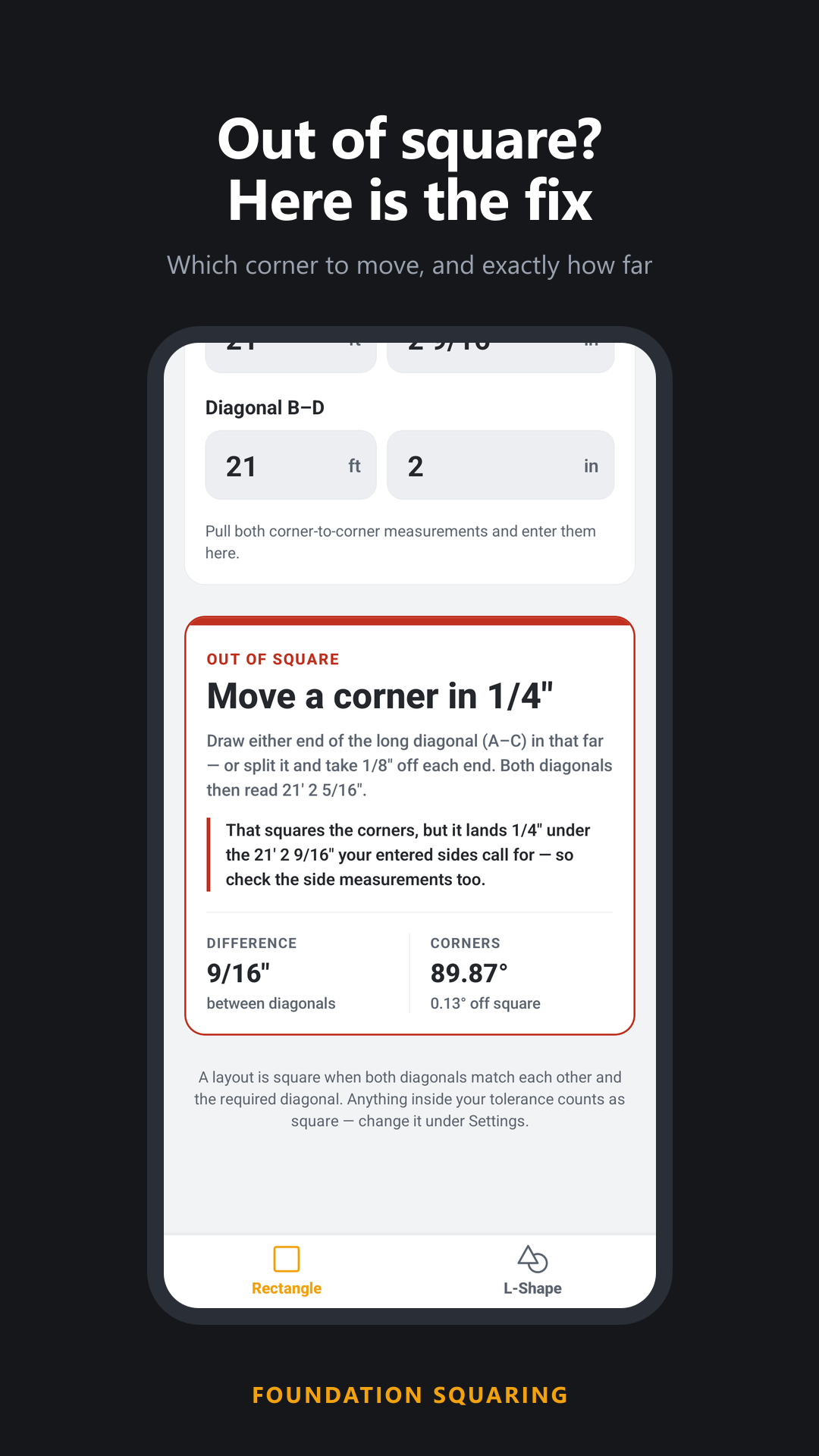
- Off-square fix — enter the two diagonals you actually measured and get a straight answer: which one is long, and how far to draw a corner in to bring the layout square. Move one corner, or split it between both ends.
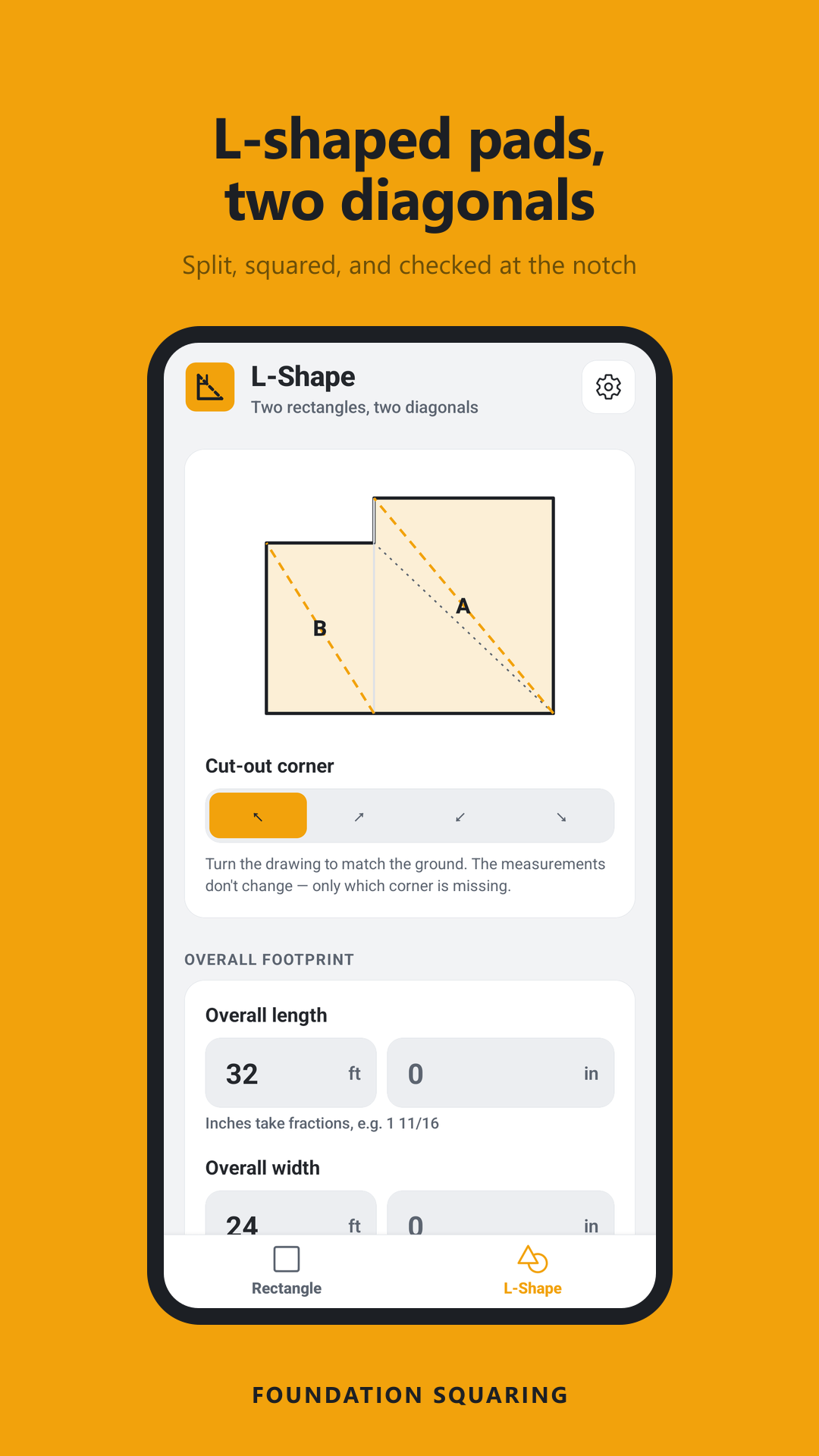
- L-shaped footprints — describe the overall size and the cut-out corner; the app splits it into two rectangles, gives a diagonal for each, and confirms the inside corner. Rotate the drawing to match what's staked on the ground.
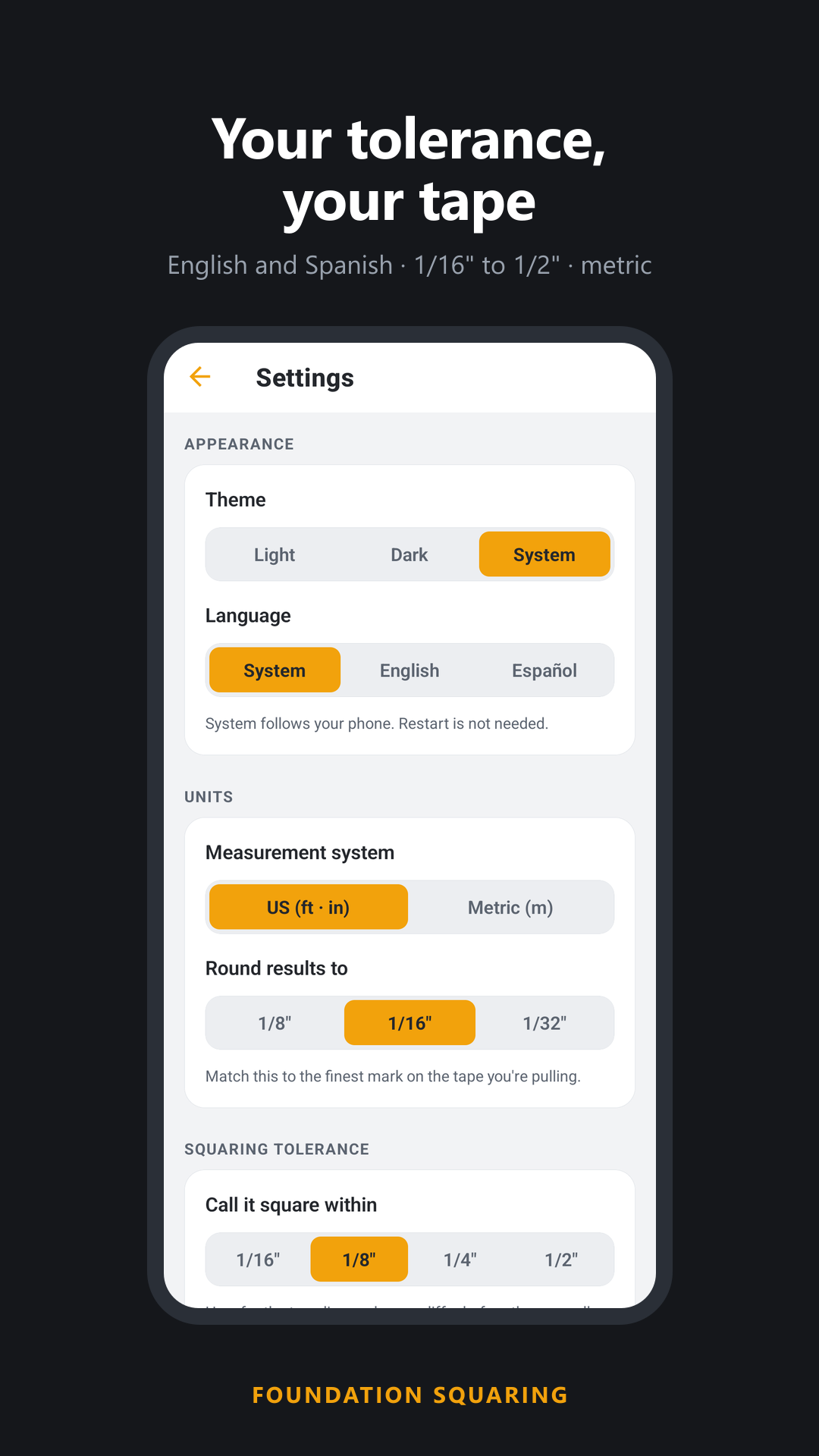
- Your tolerance — decide what counts as square: 1/16", 1/8", 1/4", 1/2", or 1–12 mm. Tight formwork and a garage pad don't need the same standard.
Built for the job site
- Feet-and-inches entry with real fractions — type 1 11/16, or 11/16, or 1.5
- Round results to 1/8", 1/16", or 1/32" to match the tape in your pocket
- Full metric mode
- Scale drawings that show which way the layout leans and which diagonal to pull
- Large, high-contrast numbers; light and dark themes
- Your measurements are still there when you come back to the phone
- Works with no signal — every calculation runs on the phone
- In English and Spanish
Who it's for
Concrete and foundation crews, framers, deck and shed builders, fence and post-hole layout, landscapers setting patios and pads, and anyone who has ever pulled a diagonal twice and gotten two different numbers.
The math
A rectangle is square when both diagonals equal the square root of length squared plus width squared — the 3-4-5 rule, generalized to any size. When the diagonals disagree, the layout has racked into a parallelogram, and the exact correction is the long diagonal minus that target.
Layout guidance only. Always confirm critical dimensions against the stamped drawings and your local code before you pour.